Why Are Traditional SIEM Approaches Falling Short?
MXDR is what happens when security leaders stop asking, “Did we detect it?” and start asking, “Did we stop it?” That shift in question is the entire point. It moves the conversation from output to outcome — from how many alerts your platform processed to whether the threat was contained before it did damage.
Because “10,000 alerts triaged” is not a security win. “Threat contained before impact” is.
What is Managed Extended Detection and Response (MXDR)?
Start with the technology genealogy. XDR — Extended Detection and Response — is the natural evolution of MDR (Managed EDR): continuous monitoring with automated detection and response across endpoints. MDR is excellent at what it does — but its frame of reference ends at the endpoint. XDR extends that same operating model — detection, automation, response — to the rest of the attack surface: network, cloud workloads, SaaS, and identity. The “extended” isn’t a marketing flourish; it’s the recognition that no real attack stays in one telemetry domain.
A modern attack doesn’t tidy itself into one tool’s view. A phishing click hits identity. The implant lands on endpoint. Lateral movement crosses the network. Exfiltration rides out through SaaS or cloud storage. XDR is built to see all of that as a single chain of behavior — not four disconnected alerts in four disconnected consoles.
MXDR — Managed Extended Detection and Response — applies that same managed operating model across all of those domains. In ArmorPoint 360, that means a 24/7 U.S.-based SOC running unlimited incident investigation, guided incident management, and containment plus remediation across the full attack surface — endpoint, network, cloud, SaaS, and identity. Repeatable workflows and data parsers carry the operational load that most security teams try (and fail) to staff for internally.
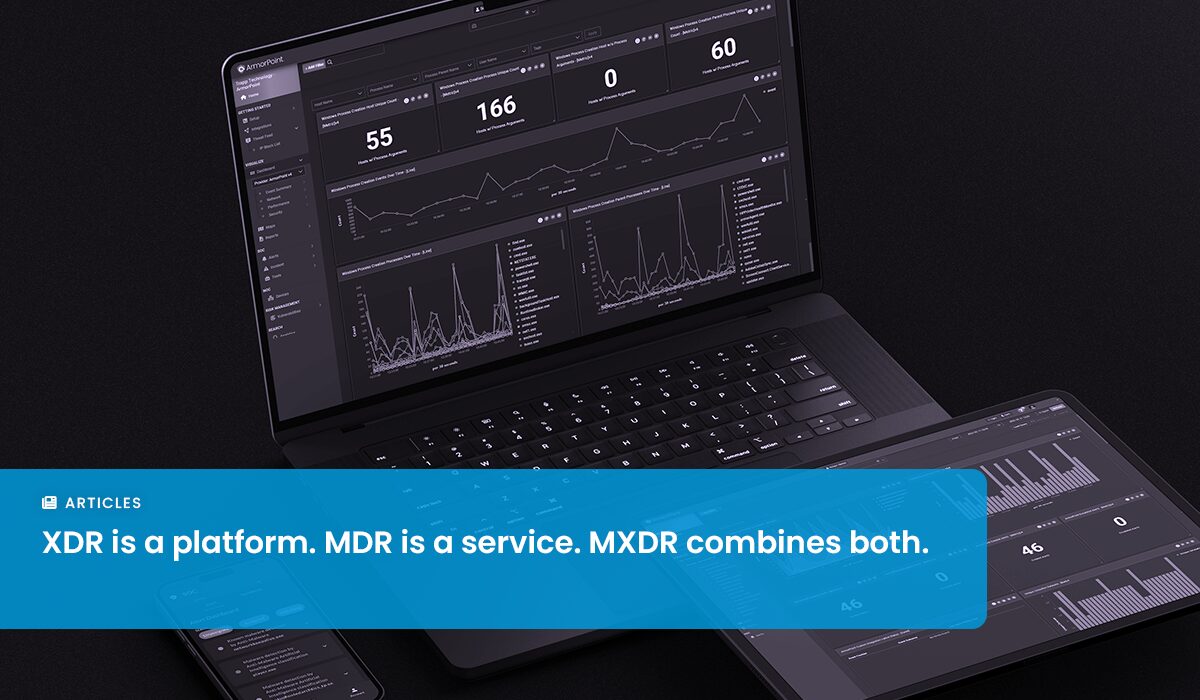
Put plainly: XDR is the platform. MXDR is the platform plus the analysts, the playbooks, and the response authority. ArmorPoint 360 delivers detection, response, and remediation as one service — not detection on a screen and remediation as somebody else’s problem. With 365 days of log retention and audit-ready reporting baked in, the compliance evidence shows up without the heroics.
The Operational Doctrine Behind Modern MXDR
The discipline behind MXDR is straightforward but unforgiving. You collect signals across every meaningful domain — not just logs, but identity, endpoint, cloud, network, and SaaS. You correlate them with context so that a 2:13 a.m. login from an unfamiliar geography doesn’t sit in a queue waiting for a human to ask the obvious question.
Then humans validate, because attackers exploit the gap between “alert” and “intent.” Containment and remediation workflows execute with speed, and the cycle hardens itself through continuous hunting and tuning. That’s the loop. Close it, and you have an operational defense. Leave it open, and you have a very expensive observation deck.
What Makes Managed XDR Different from Managed SIEM?
A Managed SIEM gives you visibility, monitoring, and escalation around a log-centric platform. An MXDR gives you 24/7 detection and response across multiple domains, with containment built into the service. The center of gravity is fundamentally different — one is logs, correlation rules, and dashboards; the other is telemetry, behavior, and response playbooks.
The bottleneck shifts as well. With Managed SIEM, the chokepoint is your internal team’s ability to investigate and act fast. With MXDR, the chokepoint is the provider’s ability to validate and execute response consistently. That distinction is most visible at 2:13 a.m.
At that hour, a Managed SIEM hands you an alert, a ticket, an escalation, and a decision to make. MXDR triages, validates, and actions the incident — containment begins while you sleep. Then there’s the cost that doesn’t show up on the invoice: the ongoing load of tuning, triage, investigation, coordination, and response ownership. SIEM keeps that load on your team. MXDR is designed to carry it.
Managed SIEM is radar. MXDR is radar plus interceptors, trained pilots, and rules of engagement. Without this, the cleanest radar track in the world is still just a notification.
When Does Managed SIEM Still Make Sense for Your Team?
The right question is what problem you’re actually trying to solve. Managed SIEM is the right answer when you primarily need log-centric visibility for investigations and compliance, when your team can reliably own response with on-call coverage that isn’t fantasy, and when you have mature incident handling and the appetite to invest in SIEM hygiene forever.
MXDR is the right answer when you need 24/7 outcomes rather than 9-to-5 awareness, when alert volume is outpacing human capacity, and when you’re juggling endpoint, identity, and cloud complexity — which you are, whether you’ve admitted it yet or not. It’s also the right answer when you’re measured on business resilience instead of tool ownership.
Most organizations don’t “graduate” from SIEM to XDR. They wake up to the fact that they never needed more alerts — they needed an operational defense.
Why Are More Organizations Adopting MXDR?
Security teams aren’t drowning because data is bad. They’re drowning because data without action is friction. Raise the standard: stop asking whether you generated an alert, and start asking whether it was investigated, contained, and resolved — fast.
Stop buying tools and hoping they become outcomes. Buy an operating model that produces them. Attackers don’t care what you can see. They care what you can stop.
Ready to Close the Loop?
If your SIEM — managed or not — has become a high-cost observation deck, it’s time to operationalize. ArmorPoint 360 is the MXDR realization of that doctrine: a 24/7 U.S.-based SOC, managed SIEM correlation across endpoint, network, cloud, SaaS, and identity, with unlimited investigation, containment, and remediation built into the service — not bolted on as a professional services line item.
Want to see what operationalized security looks like in the field? Request a demo. We’ll walk through how ArmorPoint 360 changes the math — fewer false alarms, faster containment, and a security operation that doesn’t depend on heroics.