Security operations centers (SOCs) are built to detect and respond to threats in real time. Yet in most environments, the biggest challenge is not a lack of alerts. It is the overwhelming number of them.
Modern organizations generate thousands, sometimes millions, of security alerts every day from endpoints, cloud services, identity systems, firewalls, and applications. Without the right processes and technologies in place, security teams can quickly become buried under the volume. Analysts spend more time sorting through alerts than investigating real threats.
This is where the alert queue becomes critical.
The alert queue is the operational heartbeat of a SOC. It is the place where signals from across the environment converge and where security teams determine which alerts represent real threats and which can safely be ignored. Understanding how a modern SOC manages this queue reveals a lot about the effectiveness of its security operations.
What is an Alert Queue?
An alert queue is the centralized list of security alerts that require review by SOC analysts. These alerts are generated by various security tools and platforms, including:
- Endpoint detection and response (EDR)
- Security information and event management (SIEM)
- Identity and authentication systems
- Network monitoring tools
- Email security platforms
- Cloud security services
Each alert represents a potential security event. Some may indicate routine behavior, while others could signal an active attack. Without a structured process for managing the alert queue, analysts can quickly become overwhelmed. In fact, research consistently shows that alert fatigue is one of the biggest challenges facing security teams today. A modern SOC focuses on turning a flood of alerts into a prioritized stream of actionable investigations.
Why Does Alert Prioritization Matter?
Not every alert carries the same level of risk. Some alerts may be informational or low severity, while others could indicate a serious compromise in progress. The goal of the SOC is to identify the alerts that truly matter and address them quickly before attackers can escalate their access.
Prioritization helps security teams:
- Focus on high-risk threats first
- Reduce analyst fatigue
- Improve investigation speed
- Contain threats faster
- Maintain operational efficiency
Without prioritization, SOC teams risk spending valuable time on low-impact alerts while real threats move deeper into the environment. Modern SOCs rely on a combination of technology, automation, and human expertise to ensure the right alerts receive attention first.
Step 1: Alert Ingestion and Correlation
The first step in managing an alert queue is consolidating alerts from across the environment into a single operational view.
Security platforms such as SIEM aggregate telemetry from multiple sources and apply correlation rules to identify related activity. Instead of analysts reviewing isolated alerts, the system groups related events into a broader security context.
For example, a single login anomaly might not appear dangerous on its own. But when combined with multiple failed authentication attempts, unusual geolocation activity and privileged account access, the system can correlate these signals into a higher-risk incident. This correlation step dramatically reduces noise and allows analysts to focus on meaningful patterns instead of individual alerts.
Step 2: Severity Scoring and Risk Context
Once alerts are correlated, modern SOC platforms assign severity scores based on risk factors. Severity scoring helps determine where an alert appears in the queue. Factors that influence this score often include:
- Asset criticality
- User privileges
- Known threat indicators
- Behavioral anomalies
- Threat intelligence matches
For example, an alert tied to a domain administrator account accessing a critical server will typically receive a higher severity score than the same activity occurring on a standard user endpoint. By applying context, SOC platforms elevate the alerts most likely to represent real threats.
Step 3: Automated Triage
Automation plays a critical role in keeping alert queues manageable. Automated triage processes perform initial analysis on alerts before they ever reach a human analyst. This can include enriching alerts with threat intelligence, pulling asset data from configuration databases, checking known indicators of compromise, or gathering endpoint and identity context. Automation can also close alerts that clearly represent benign activity. For example, if a known system administrator performs a scheduled task that triggers a rule, automation may suppress or automatically resolve that alert. By filtering out known-good activity, SOC teams dramatically reduce the number of alerts requiring manual review.
Step 4: Analyst Investigation
After automated triage, the remaining alerts enter the analyst investigation phase. SOC analysts review the alert details, validate the context, and determine whether the activity represents:
- A false positive
- Suspicious activity requiring deeper investigation
- A confirmed security incident
Modern SOC workflows often assign alerts to different analyst tiers based on complexity. Tier 1 analysts handle initial validation, while Tier 2 and Tier 3 analysts investigate more advanced threats. Effective alert queues ensure analysts always have the information they need to quickly understand what happened, where it occurred, and how it may impact the environment.
Step 5: Response and Containment
When an alert is confirmed as a security incident, response actions begin. Depending on the SOC's capabilities and integrations, response may include:
- Isolating compromised endpoints
- Disabling user accounts
- Blocking malicious IP addresses
- Terminating suspicious processes
- Containing lateral movement
The faster the SOC moves from alert detection to response, the smaller the potential impact of an attack. This is why alert queue efficiency is so important. Every minute spent sorting alerts is a minute attackers can use to escalate their access.
The Role of Human Expertise in Alert Management
Technology plays an essential role in organizing alerts, but human analysts remain the most important element of the SOC. Experienced analysts recognize subtle attack patterns that automated systems may miss. They understand attacker behavior, investigate anomalies, and make judgment calls that automation alone cannot. A mature SOC blends automation with human expertise to ensure alerts are not only prioritized correctly but also investigated with the right level of scrutiny.
Why Many Security Teams Struggle with Alert Queues
Despite the importance of alert management, many organizations still struggle with overwhelming alert queues. Common challenges include:
- Too many disconnected security tools
- Poorly tuned detection rules
- Lack of contextual data
- Limited analyst resources
- Inefficient investigation workflows
These challenges often result in large backlogs of alerts and delayed response times.Organizations without a dedicated SOC team may find it especially difficult to maintain continuous monitoring and investigation coverage.
How Managed SOC Services Improve Alert Management
For many organizations, partnering with a managed SOC provider offers a more efficient approach to handling alert queues. A managed SOC combines advanced detection technology with a team of dedicated security analysts who monitor alerts around the clock. Instead of relying on internal staff to review alerts during business hours, organizations gain continuous coverage and faster investigation.
With a managed SOC, organizations benefit from:
- 24/7 monitoring and alert triage
- Experienced analysts investigating threats
- Faster response and containment
- Reduced alert fatigue for internal teams
- Consistent security operations processes
This approach allows organizations to maintain strong detection and response capabilities without needing to build a full SOC internally.
Conclusion
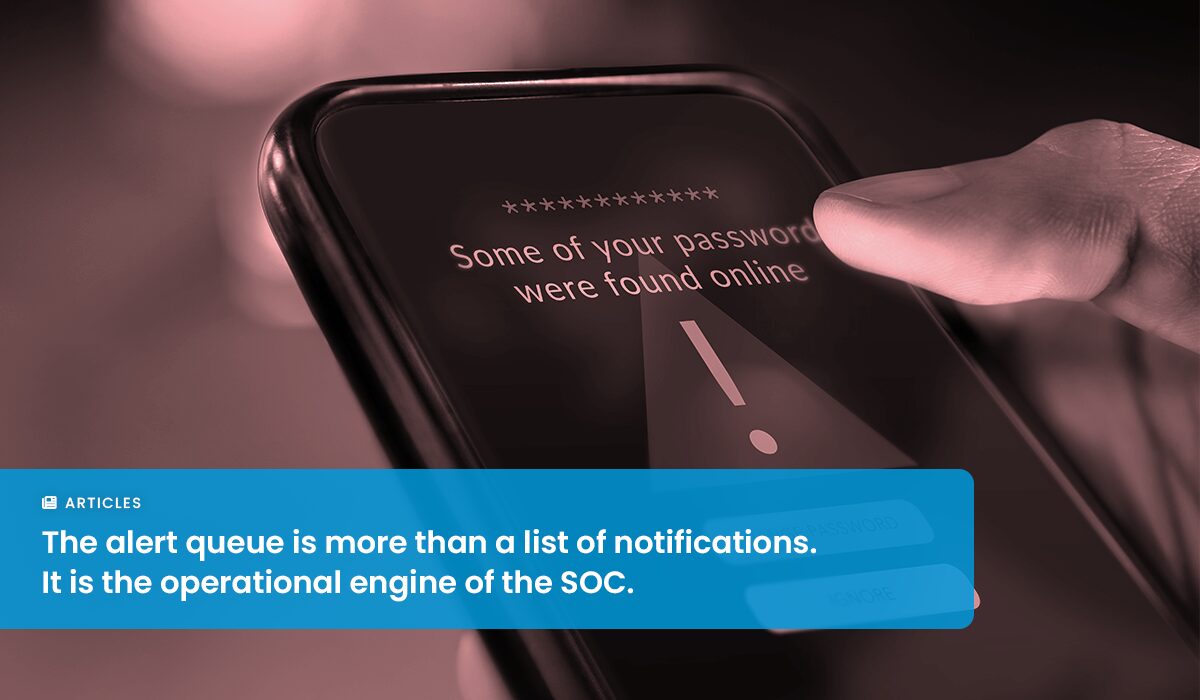
The alert queue is more than a list of notifications. It is the operational engine of the SOC. When managed effectively, it allows security teams to cut through noise, prioritize meaningful threats, and respond quickly when incidents occur. But when poorly managed, it becomes a bottleneck that slows investigations and increases risk.
Modern SOCs rely on correlation, risk scoring, automation, and skilled analysts to ensure the alerts that matter most rise to the top. By transforming overwhelming alert volume into prioritized investigations, security teams can focus on what matters most: stopping threats before they become breaches.
See how ArmorPoint helps security teams cut through alert noise. Request a demo of ArmorPoint Managed SOC today.