TL;DR
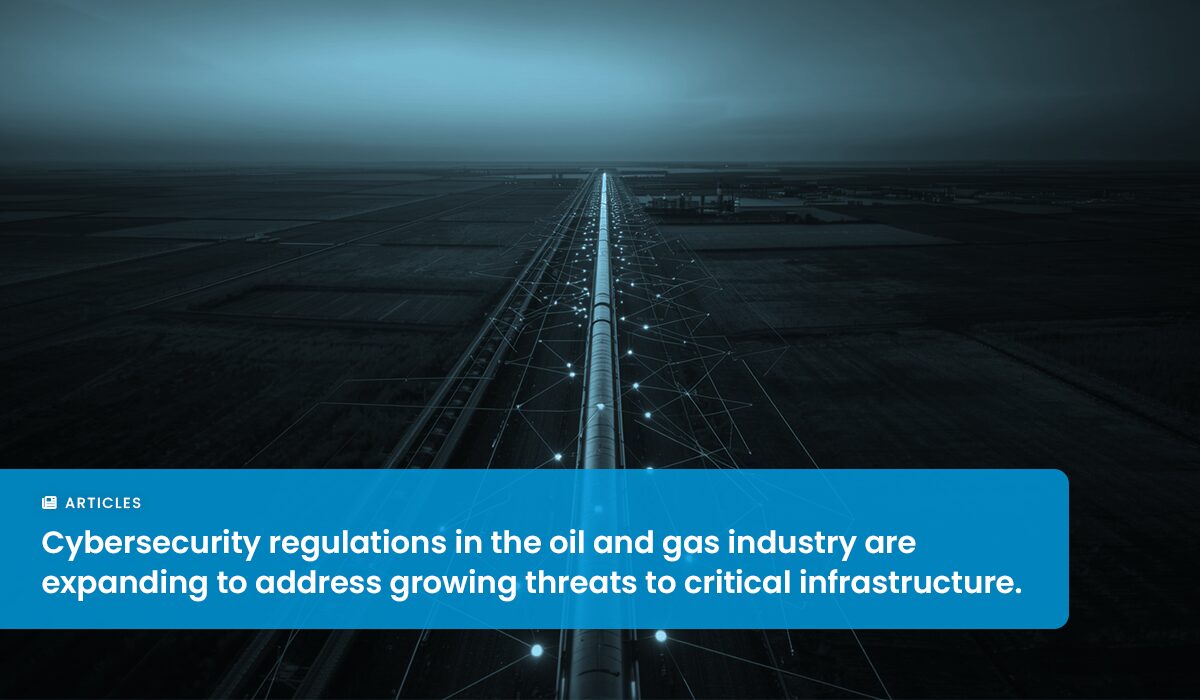
Cybersecurity regulations in the oil and gas industry are expanding to address growing threats to critical infrastructure. From TSA pipeline directives to global frameworks, organizations are expected to strengthen visibility, incident response, and operational resilience. Compliance alone isn’t enough. Security operations have to be continuous, integrated, and aligned to real-world risk.
Why Cybersecurity Regulations Are Increasing in Oil and Gas
Cybersecurity regulations in oil and gas aren’t emerging in a vacuum. They’re a direct response to how threat activity has evolved. This industry sits at the center of critical infrastructure, and when systems are disrupted, the impact extends far beyond a single organization. Fuel supply, transportation, manufacturing, and even national security can all be affected. That level of risk has pushed regulators to take a more active role in defining what “adequate security” actually looks like.
At the same time, attacks are becoming more targeted and more operationally disruptive. Incidents affecting pipelines and energy providers have made it clear that traditional IT-focused security controls aren’t enough anymore. Regulators are now focused on ensuring organizations can not only prevent attacks, but also detect and respond to them in real time. The result is a growing set of requirements centered around visibility, resilience, accountability, and operational readiness across both IT and OT environments.
What Regulations Apply to the Oil and Gas Industry?
Unlike industries such as healthcare or finance, oil and gas cybersecurity regulations aren’t defined by one single framework. Instead, they’re shaped by a combination of government directives, industry standards, and regional requirements.
In the United States, one of the biggest developments has been the introduction of Transportation Security Administration (TSA) pipeline security directives. These directives require operators to implement cybersecurity incident reporting, designate cybersecurity coordinators, conduct vulnerability assessments, and develop incident response and recovery plans. These requirements were introduced in response to real-world attacks that exposed how vulnerable critical infrastructure can be when operational systems are disrupted.
Beyond TSA directives, many organizations also align to frameworks like the NIST Cybersecurity Framework (CSF), which provides guidance around identifying, protecting, detecting, responding to, and recovering from cyber threats. Globally, the trend is similar. Governments are increasing oversight of critical infrastructure sectors and expecting organizations to prove they can maintain operational resilience in the face of growing cyber risk.
Compliance Is Expanding Beyond IT Into OT Environments
One of the biggest shifts happening in oil and gas regulation is the growing focus on operational technology. Historically, compliance efforts were centered around traditional IT systems like endpoints, servers, and data protection. Today, regulators are paying much closer attention to the systems that control physical operations, including industrial control systems, SCADA environments, and remote monitoring platforms.
These systems are now firmly within scope because they’re directly tied to operational continuity and safety. The challenge is that many OT environments weren’t built with modern cybersecurity in mind. They often lack detailed logging, strong authentication, and continuous monitoring capabilities, creating a major gap between what regulations expect organizations to demonstrate and what many environments are currently capable of supporting. As IT and OT environments continue converging, that visibility gap becomes even harder to manage.
The Real Challenge: Meeting Requirements Without Slowing Operations
For oil and gas organizations, compliance can’t come at the expense of uptime. Operational systems can’t simply be taken offline for patching or maintenance whenever needed, and remote facilities make monitoring more difficult. Many legacy systems also don’t support newer security controls or integrations, which creates constant tension between operational realities and regulatory expectations.
At the same time, regulations are becoming more outcome-focused. It’s no longer enough to simply have policies documented. Organizations are increasingly expected to prove they can detect threats in real time, investigate suspicious activity quickly, and respond before incidents escalate into operational disruption. That requires a level of security maturity many organizations are still working toward.
Why Compliance Alone Doesn’t Reduce Risk
One of the biggest misconceptions in cybersecurity is that compliance automatically equals security. It doesn’t. Compliance establishes a baseline, but it doesn’t guarantee threats will be detected, investigated, or contained effectively. Many organizations technically meet regulatory requirements while still struggling with limited visibility, overwhelming alert volumes, and slow response times.
In an industry where threats are increasingly targeting operations directly, those gaps become dangerous very quickly. That’s why security has to function as an ongoing operation, not just a compliance initiative. Organizations need continuous monitoring, contextual detection, and coordinated response capabilities that extend across their entire environment.
What Effective Regulatory Alignment Actually Looks Like
Organizations that are successfully navigating cybersecurity regulations in oil and gas are taking a far more operational approach to security. Instead of treating compliance as a standalone project, they’re building security operations that naturally support both regulatory requirements and real-world threat defense.
That includes continuous monitoring across IT and OT environments, centralized visibility to reduce blind spots, contextual threat detection that prioritizes what actually matters, and coordinated response workflows that reduce time to containment. When security operations are functioning effectively, compliance becomes much easier to maintain because the organization already has the visibility and processes regulators expect to see.
How ArmorPoint Helps Oil and Gas Organizations Meet Regulatory Expectations
This is where organizations are increasingly turning toward managed security operations, and where ArmorPoint fits directly into the equation. ArmorPoint combines cloud-native SIEM visibility with a 24/7 U.S.-based SOC, helping oil and gas organizations strengthen security operations while supporting evolving compliance requirements.
With ArmorPoint, organizations can improve visibility across regulated environments by centralizing logs and telemetry across IT systems, cloud environments, and operational infrastructure to create a more unified view of activity. ArmorPoint also helps reduce alert fatigue by ensuring every alert is reviewed and validated by experienced analysts, allowing internal teams to focus on real threats instead of getting overwhelmed by noise.
At the same time, ArmorPoint strengthens incident response readiness by accelerating detection, investigation, and response workflows, helping organizations support requirements around incident handling and operational resilience. Organizations also don’t need to rip and replace their current security stack. ArmorPoint integrates with existing technologies to improve visibility and response without disrupting operations.
Cybersecurity Regulations Will Continue to Evolve
The regulatory landscape in oil and gas isn’t static. It’s evolving alongside the threat landscape. As attacks become more sophisticated and more operationally disruptive, regulations will continue emphasizing faster detection and response, greater visibility across environments, and stronger accountability for protecting critical infrastructure.
Organizations that treat compliance as a one-time initiative will struggle to keep up. The ones building adaptable, operational security models will be better positioned to meet both regulatory expectations and real-world threats.
Cybersecurity Is Now Both a Compliance and Operational Priority
In oil and gas, cybersecurity is no longer just about meeting requirements. It’s about keeping operations running safely, reliably, and resiliently in the face of constant threat activity. Regulations are raising the bar because the risks are increasing, which means security has to be continuous, operational, and aligned with how these environments actually function in the real world. That’s where organizations will see the biggest impact—not just in compliance, but in resilience.
Ready to take the next step?
See how ArmorPoint helps oil and gas organizations strengthen visibility, improve threat detection, and support evolving cybersecurity compliance requirements with a unified SIEM and 24/7 SOC approach.
Request a demo to see how ArmorPoint can help secure your operations without adding unnecessary complexity.