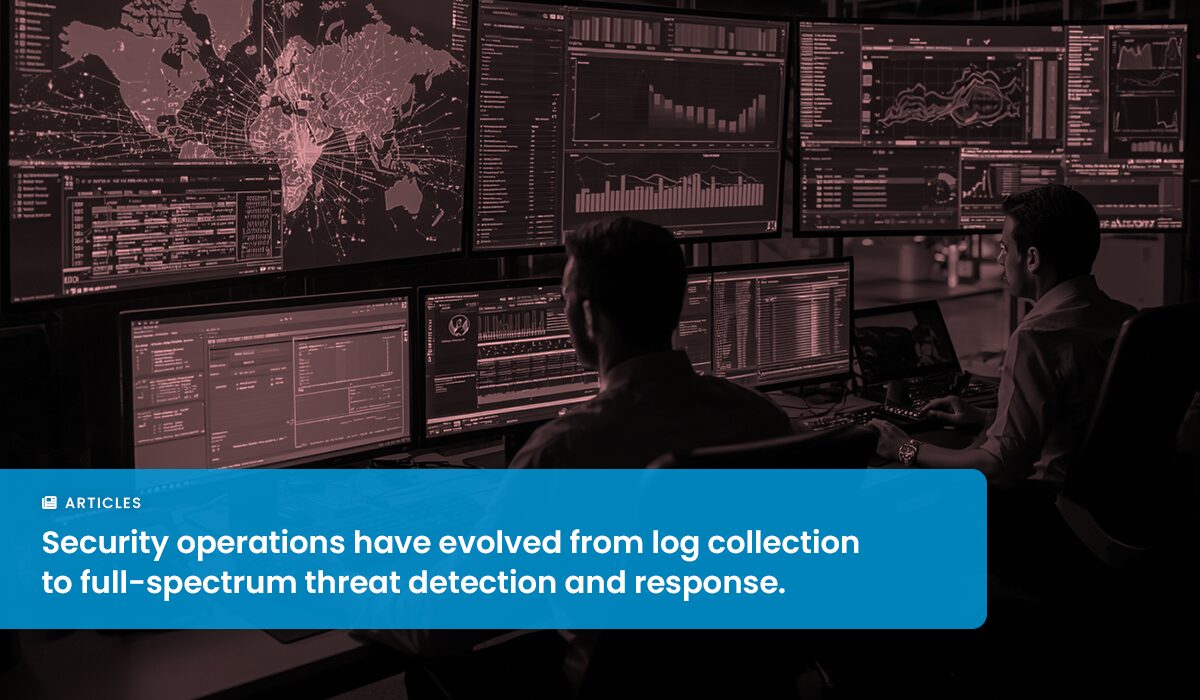
Security Information and Event Management platforms are a core part of modern security operations. At the center of every SIEM are detection rules, which help identify suspicious activity, surface threats, and trigger investigations.
But detection rules are only effective when they are accurate. Out of the box rules provide a baseline, not a finished strategy. Without tuning, organizations quickly run into alert fatigue, missed signals, and inefficient response workflows.
Understanding how SIEM detection rules work, and why tuning is essential, is one of the most important steps toward building a high-performing security operation.
What Are SIEM Detection Rules?
SIEM detection rules are logic-based conditions that analyze collected security data to determine whether activity may indicate malicious behavior. These rules evaluate logs and telemetry from endpoints, identity systems, cloud services, firewalls, applications, and other sources.
When a rule matches a suspicious pattern, the SIEM generates an alert for analysts to review.
Detection rules are commonly designed to detect:
- Known indicators of compromise
- Behavioral anomalies
- Policy violations
- Threshold-based suspicious activity
- Correlated event sequences across systems
The purpose is to highlight meaningful security events while filtering out routine activity.
Why Do Out-of-the-Box SIEM Rules Fall Short?
Most SIEM platforms come with prebuilt detection content, but these rules are designed to apply broadly across many industries and environments. That generalization creates limitations.
Default rules often do not reflect an organization’s normal workflows, infrastructure, or risk priorities. A login pattern that looks suspicious in one environment may be completely normal in another.
Out-of-the-box rules often lead to:
- Excessive false positives
- Alert fatigue for analysts
- Missed threats that do not match generic patterns
- Inefficient response workflows
Prebuilt detections are a starting point, but tuning is what makes them operationally effective.
What is SIEM Detection Rule Tuning?
Detection rule tuning is the process of refining SIEM rules to improve accuracy, relevance, and signal quality. Tuning aligns detection logic with the organization’s environment and threat landscape.
This can include adjustments such as:
- Modifying thresholds and time windows
- Filtering out known benign activity
- Adding identity and asset context
- Improving correlation across multiple event types
The goal is simple: reduce unnecessary alerts while improving confidence in the alerts that remain.
How Does Rule Tuning Reduce False Positives?
False positives are one of the biggest challenges in security operations. When analysts are flooded with low-quality alerts, response slows down and critical threats can be missed.
Tuning reduces false positives by incorporating environmental context. For example, administrative activity may not represent risk if it aligns with an approved workflow. Repeated authentication attempts may be expected for service accounts or remote access tools.
Effective tuning ensures alerts represent meaningful anomalies rather than routine business behavior.
How Does SIEM Tuning Improve Threat Detection Accuracy?
Tuning is not only about reducing noise. It is also about improving detection effectiveness.
Well-tuned rules are more likely to identify true threats because they focus on attacker behavior instead of isolated technical events. Instead of alerting on one suspicious login, tuned detections may recognize an entire compromise pattern.
Tuning strengthens detection of threats such as:
- Credential misuse and privilege escalation
- Lateral movement across systems
- Persistence techniques
- Insider activity and abnormal access patterns
When alerts are accurate and contextual, security teams can detect and respond earlier in the attack lifecycle.
What Role Does Context Play in SIEM Detection Rules?
Context is what transforms raw alerts into actionable intelligence.
An alert becomes far more meaningful when analysts understand:
- Which asset is involved and how critical it is
- Whether the user has elevated privileges
- If vulnerabilities exist on the affected system
- Whether the activity deviates from baseline behavior
Without context, teams waste time investigating unclear alerts. With context, they can prioritize response immediately.
Context-driven tuning is one of the most important factors in improving SIEM accuracy.
How Often Should SIEM Detection Rules Be Tuned?
Detection rule tuning is not a one-time project. Environments change constantly, and attackers evolve just as quickly.
SIEM tuning should occur:
- During initial deployment and onboarding
- After major infrastructure or cloud migrations
- When new tools or integrations are added
- Following incident investigations and lessons learned
- On a regular quarterly review cycle
Continuous tuning ensures detection content stays aligned with real-world conditions and evolving risk.
What Are Common Mistakes in SIEM Rule Tuning?
Organizations often struggle with tuning due to limited resources or lack of expertise. One common mistake is disabling noisy rules entirely rather than refining them. Another is over-tuning to the point where detections become too narrow.
Common tuning pitfalls include:
- Prioritizing fewer alerts over better alerts
- Suppressing detections without documentation
- Ignoring detection gaps while chasing false positives
- Failing to adapt rules as attacker techniques evolve
Effective tuning requires balance between noise reduction and threat visibility.
How Does Managed SIEM Improve Detection Rule Tuning?
Detection rule tuning requires continuous oversight, threat intelligence, and hands-on analyst experience. For many organizations, especially those with lean security teams, maintaining that level of effort internally is difficult.
Managed SIEM services provide:
- Expert-led tuning based on real investigations
- Continuous optimization using current threat intelligence
- Environment-specific customization
- Reduced burden on internal teams
- Higher confidence detections over time
Instead of relying on static rules, managed teams refine detection logic continuously as threats and environments change.
Why is Detection Rule Tuning Critical for Modern Security Operations?
Modern security teams cannot rely on default detections alone. Threats are more sophisticated, environments are more complex, and alert volume continues to grow.
Detection rule tuning is what enables SIEM platforms to deliver real value by:
- Improving alert accuracy
- Reducing analyst fatigue
- Accelerating response time
- Strengthening overall security posture
Organizations that invest in tuning move from reactive alert handling to proactive, intelligence-driven threat detection.
Conclusion
SIEM detection rules are foundational to effective security operations, but they require refinement to stay accurate and actionable. Tuning transforms generic detections into high-confidence alerts aligned with business risk.
For organizations looking to improve SIEM performance without adding internal overhead, managed SIEM services provide a scalable way to maintain continuous optimization and expert-driven detection.
ArmorPoint helps organizations strengthen SIEM accuracy through ongoing tuning, contextual correlation, and 24/7 managed detection expertise.
Ready to reduce alert noise and improve detection accuracy? Request a demo of ArmorPoint’s Managed SIEM platform today.