Security teams are trained to watch for suspicious logins, unusual network traffic, and alerts from security tools. But some of the earliest signs that something is wrong begin long before a SIEM rule fires. When an endpoint suddenly slows down or a server starts consuming resources at an unusual rate, it is often the first clue that something is happening behind the scenes.
These performance anomalies are more than operational headaches. They are valuable security signals. When paired with traditional threat telemetry, they help analysts see the fuller story behind what is happening in the environment. This is where integrated performance monitoring becomes an essential capability for modern security operations.
Why Performance Data Matters for Security Teams
Every system has a baseline. When that baseline changes unexpectedly, it can be a sign of malicious behavior. For example, ransomware does not immediately begin encrypting files. It often prepares the environment first, which can cause CPU spikes or unusual disk activity. Crypto-mining malware typically reveals itself through sustained resource consumption. Even stealthy credential theft tools can leave small but noticeable performance footprints.
Performance monitoring helps teams uncover these early clues. Instead of relying solely on logs or signature matches, analysts gain visibility into how the system is behaving at the moment suspicious activity begins. This context is especially valuable when threats blend into the noise of everyday operations.
Bringing Operational and Security Telemetry Together
Traditionally, performance monitoring has been considered an IT responsibility, separate from the security stack. But when operational data and security data remain isolated, analysts miss opportunities to detect threats earlier and understand their impact faster.
ArmorPoint removes this barrier. Our agents collect real-time performance metrics such as CPU utilization, memory consumption, disk usage, and disk I/O and feed them into the same engine that correlates security alerts. This gives the SOC a unified view of how systems behave before, during, and after an event. Analysts no longer need to guess whether a performance issue could be related to a threat. They can see the correlation instantly. This integrated approach strengthens visibility and helps teams recognize anomalies that might have gone unnoticed.
Spotting Threats Earlier in the Attack Chain
Many attacks begin subtly. A newly compromised system may run unfamiliar processes or begin staging data long before an alert is triggered. In these early stages, performance irregularities often become the first outward sign that something is wrong.
Consider a simple scenario. A server begins showing increased disk activity late at night when no scheduled tasks are running. Alone, this may look like a routine performance issue. But when combined with authentication events, new processes launching, or communication with external hosts, the picture becomes much clearer. It often reveals that an attacker is preparing to execute the next phase of the attack.
This early visibility gives security teams more time to respond, contain the threat, and reduce the blast radius. In many cases, catching the abnormal performance pattern early can prevent the incident from escalating.
Reducing MTTR Through Better Context
Once an alert fires, the fastest way to slow down an investigation is missing context. Analysts need to confirm whether the affected system appeared healthy, whether performance shifted around the time of the alert, and whether any suspicious processes were already in play.
Without integrated performance monitoring, this means manual data requests, waiting on IT teams, or searching through logs. With integrated telemetry, that context is already available inside the alert.
Performance data shows how the system behaved leading up to the event, which helps analysts quickly form hypotheses and focus their investigation. It also reveals whether instability is ongoing, which helps determine the urgency and scope of remediation efforts. All of this contributes to a measurable reduction in MTTR.
Strengthening Continuous Monitoring Across the Environment
Continuous monitoring is more than watching logs. It requires ongoing awareness of what systems are doing and how they are performing. Performance telemetry fills an essential gap by helping teams differentiate between normal fluctuations and meaningful anomalies.
When performance trends and security signals come together within one platform, teams gain a sharper understanding of:
- What a threat looks like in its earliest moments
- How attacks impact system behavior
- Where to prioritize resources and response efforts
This unified visibility supports faster decisions, more accurate triage, and a more proactive security posture.
Conclusion
Performance monitoring is often overlooked as a security tool, yet it provides some of the most valuable early-warning indicators available. When organizations combine security telemetry with real time operational context, detection becomes sharper, investigations move faster, and critical response times improve.
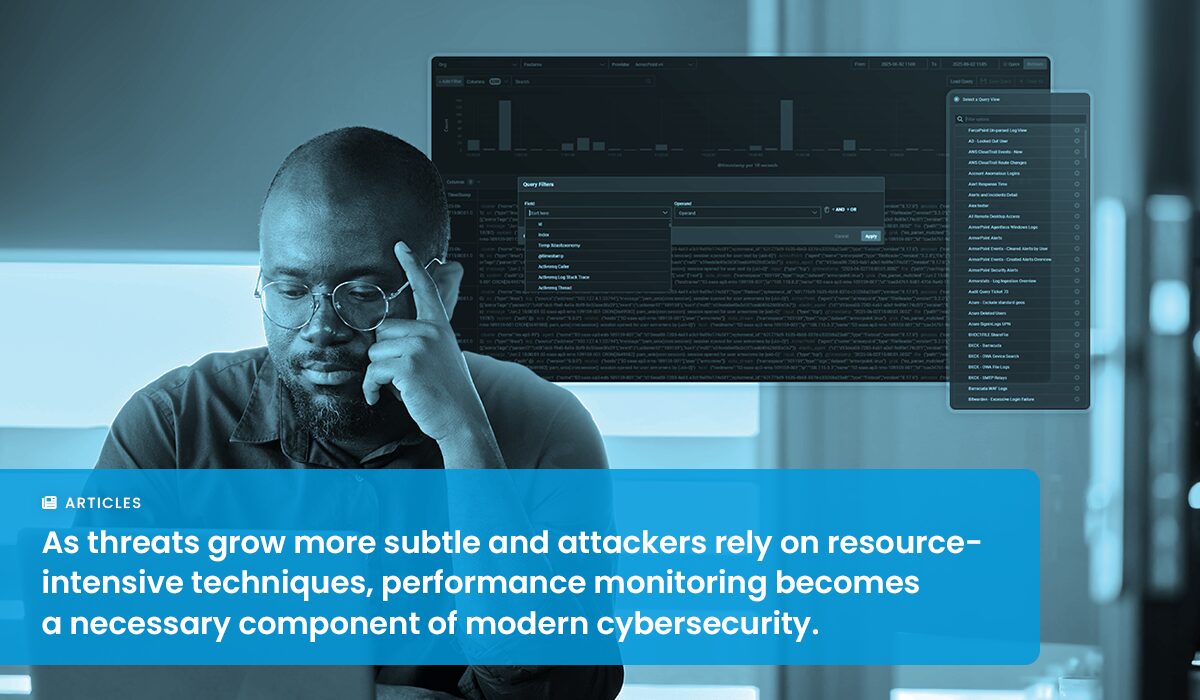
As threats grow more subtle and attackers rely on resource-intensive techniques, performance monitoring becomes a necessary component of modern cybersecurity. Integrated into a Managed SIEM and supported by a 24/7 SOC, it helps organizations move from reactive defense to proactive detection.
Ready to see how integrated performance monitoring enhances visibility and reduces MTTR across your environment? Request a demo today and experience the ArmorPoint difference.