TL;DR
High-impact data breaches in K–12 districts reveal vulnerabilities in access controls, vendor management, and outdated IT systems. These incidents highlight the need for proactive defenses, staff training, and continuous monitoring to safeguard student and staff data.
Over the past five years, K-12 school districts across the United States have increasingly found themselves in the crosshairs of cybercriminals. In fact, the U.S. Department of Education reports that school districts experience an average of five cyber incidents per week. From ransomware attacks that disrupt learning to data breaches exposing sensitive student and staff information, the education sector has faced significant cybersecurity challenges. While some K-12 data breaches make headlines, many others quietly expose data or disrupt operations without widespread awareness. Regardless of the visibility, these incidents leave a lasting impact—disrupting education, eroding public trust, and in some cases, endangering student safety.
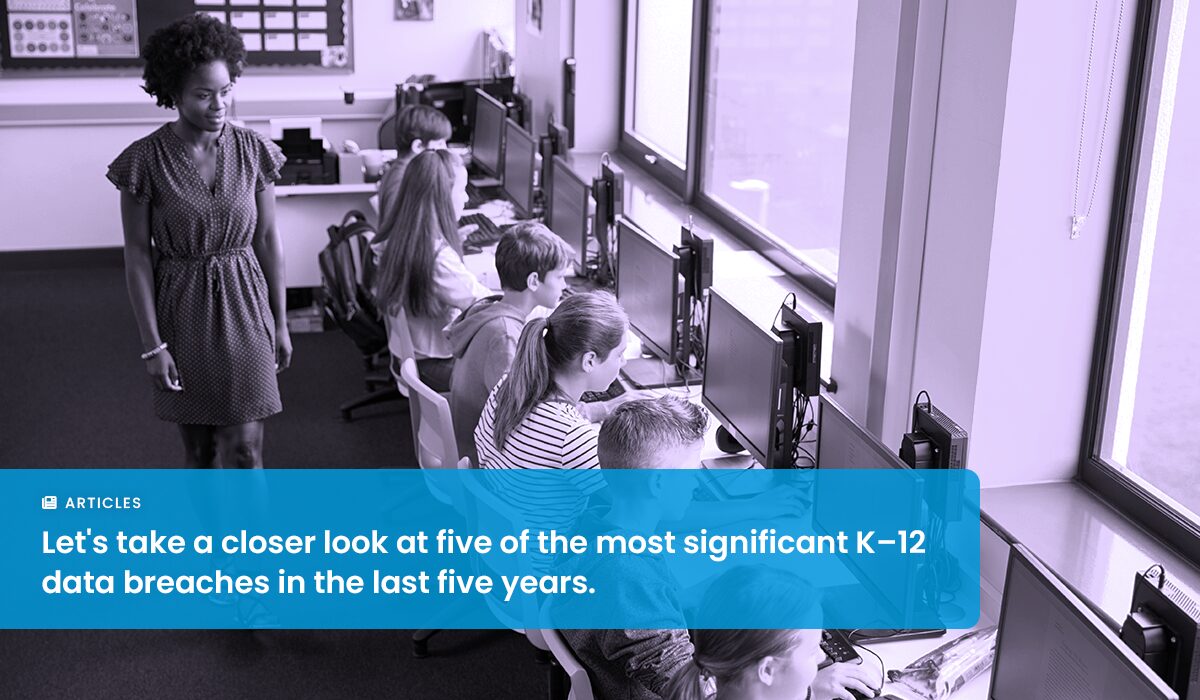
To better understand how schools can defend against these evolving threats, let's take a closer look at five of the most significant K-12 data breaches in the last five years. By learning from these real-world cases, school IT leaders and cybersecurity professionals can gain insights into practical strategies for safeguarding educational environments.
Top 5 Data Breaches in K-12 Schools
K-12 Data Breach #1: PowerSchool Data Breach (2024)
In 2024, PowerSchool, a widely used educational platform, experienced a significant data breach that affected approximately 800,000 Texans, including students and staff. PowerSchool is commonly used to manage student information systems (SIS), grading, and attendance tracking.
During the breach, cybercriminals accessed personally identifiable information (PII), including Social Security Numbers, home addresses, contact details, and other sensitive data. The breach occurred because of a vulnerability within the platform, exploited by attackers who gained unauthorized access to the system.
The exposure of PII can lead to identity theft, fraud, and other long-term issues for affected students and staff. For schools, the breach eroded trust among parents, staff, and the community, raising questions about data protection practices.
Key Takeaways:
Third-party vendor access poses a major security risk to school districts. Schools frequently rely on third-party platforms for administrative and educational purposes without thoroughly vetting their security practices. Knowing this, K-12 schools should:
- Continuously evaluate and monitor third-party platforms to identify vulnerabilities.
- Require vendors to meet stringent security standards, including data encryption and breach notification protocols.
- Conduct regular risk assessments focused on vendor management, ensuring that contracted services align with the district’s security policies.
- Implement a robust third-party risk management framework to proactively address potential threats.
Free Guide: How Schools and Universities Can Strengthen Detection, Response, and Resilience
Get the GuideK-12 Data Breach #2: NYC DOE / Illuminate Education Breach (2022–2024)
Between 2022 and 2024, the NYC Department of Education (DOE) and other school districts across the United States faced a data breach involving Illuminate Education, an educational data and analytics platform. The breach affected over 1 million students and staff members.
One of the most concerning aspects of this breach was the delayed detection and notification. The breach went undetected for months and was publicly disclosed only after pressure from advocacy groups and affected families. By that time, attackers had ample opportunity to exploit the stolen data.
The breach exposed a range of sensitive data, including student grades, disciplinary records, and other PII. The prolonged exposure of this data raised concerns about the potential for long-term misuse and identity theft. Additionally, the breach damaged the reputation of the NYC DOE and led to legal actions from affected parties.
Key Takeaways:
Delayed detection and response dramatically increase the damage caused by a data breach. Schools that lack continuous monitoring may fail to identify intrusions promptly, allowing cybercriminals more time to exploit stolen information. Knowing this, K-12 schools should:
- Deploy a Managed SOC to provide 24/7 monitoring, rapid detection, and response to potential threats.
- Implement robust logging and alerting for third-party data access, ensuring that unauthorized activities are flagged immediately.
- Establish clear incident response protocols to act swiftly when a breach is detected.
- Conduct regular security audits on third-party systems to detect and mitigate risks early.
K-12 Data Breach #3: Des Moines Public Schools Ransomware Attack (2023)
In 2023, Des Moines Public Schools faced a ransomware attack that forced the district to cancel classes and disrupted administrative operations for several days. The attackers exfiltrated sensitive data and demanded a ransom to restore access to encrypted files.
The school district lacked a comprehensive incident response plan, leading to confusion and delays in restoring operations. As a result, the ransomware attack severely impacted not only educational activities but also internal communications and financial processes.
The disruption caused significant academic setbacks, particularly for students preparing for exams and critical assessments. Additionally, the lack of a pre-established response strategy prolonged the recovery process, increasing downtime and financial costs.
Key Takeaways:
A clearly-defined incident response plan is essential. Schools that do not prepare for cyber incidents may face prolonged disruptions and increased recovery costs. Knowing this, K-12 schools should:
- Establish and routinely test an incident response plan tailored for educational environments.
- Back up critical data regularly, ensuring that offline copies are available to mitigate ransomware attacks.
- Train staff on ransomware recognition and response, including how to report suspicious activities immediately.
- Implement ransomware-specific defense tactics such as endpoint detection and response (EDR) and network segmentation to limit the spread of attacks.
K-12 Data Breach #4: Baltimore County Public Schools – Ryuk Ransomware (2020)
In 2020, Baltimore County Public Schools became a victim of Ryuk ransomware. The attack affected approximately 115,000 students, shutting down systems for days. Inadequate planning and outdated systems made recovery slow and complex.
The attackers exploited known vulnerabilities within legacy systems. With no established contingency plan, the district struggled to restore data and services, disrupting both education and administrative functions.
This incident highlighted the risks of outdated technology and insufficient planning. Students lost access to remote learning tools, and staff could not perform essential tasks.
Key Takeaways:
Known vulnerabilities and outdated systems increase the risk of cyberattacks. Maintaining up-to-date systems and proactive patch management can significantly reduce risk. Knowing this, K-12 schools should:
- Conduct regular vulnerability assessments to identify and address security gaps.
- Prioritize patch management to keep systems updated and reduce attack surfaces.
- Replace outdated systems that cannot be adequately secured.
- Invest in cybersecurity training for IT staff to recognize and respond to evolving threats.
K-12 Data Breach #5: Miami-Dade County Public Schools DDoS Attack (2020)
During the 2020 school year, a student conducted a large-scale Distributed Denial-of-Service (DDoS) attack, disrupting virtual learning for thousands of students. The attack overwhelmed servers, blocking access to remote classes.
The investigation revealed that weak access controls and insufficient network monitoring allowed the student to execute the attack.
The DDoS attack disrupted education for days, impacting students, teachers, and families who relied on virtual learning during the pandemic. The incident also highlighted the potential for insider threats within educational environments.
Key Takeaways:
Insider threats can come from unexpected sources, including students. Schools need to implement stronger internal controls and educate users on responsible internet practices. Knowing this, K-12 schools should:
- Restrict administrative privileges to essential personnel only.
- Implement monitoring solutions to detect unusual activity from within the network.
- Educate students, teachers, and staff on the impact of cyber misuse and the consequences of attacks.
- Develop an internet usage policy that addresses potential misuse.
How ArmorPoint Helps School Districts Stay Secure
Managing cybersecurity in schools can be daunting, but proactive strategies can mitigate risks. ArmorPoint offers tailored solutions to help K-12 schools strengthen their security posture:
- Managed SOC & SIEM: 24/7 detection and response to both known and unknown threats, ensuring rapid incident handling.
- Vendor Risk Monitoring: Tools to assess and manage risks associated with third-party software, platforms, and services.
- Incident Response Services: Comprehensive support to help school leaders act quickly and effectively during an attack, minimizing disruption.
- User Awareness Training: Empowering staff and students to recognize and respond to cyber threats, reducing the risk of human error.
Conclusion
The rise in K-12 data breaches highlights the urgent need for improved cybersecurity measures. By learning from past breaches and implementing proactive strategies, schools can protect sensitive data, maintain operational continuity, and preserve public trust.
Let’s discuss how ArmorPoint can help your district build a resilient cybersecurity framework. Schedule a consultation today to learn how you can protect your school district with expert-managed solutions.