
As businesses become increasingly reliant on digital platforms, the potential impact of security breaches grows, making it essential to have a well-structured approach to managing cybersecurity incidents. According to IBM, “Organizations aren’t containing breaches fast enough. It takes 277 days on average to identify and contain a breach: 207 days to identify and 70 days to contain. That’s a 3.5% decrease from the previous year, which averaged 287 days. Meanwhile, cyberattacks are much faster.”
The National Institute of Standards and Technology (NIST) Special Publication 800-61 provides comprehensive guidelines designed to assist organizations in developing effective incident response capabilities. This blog post delves into the NIST SP 800-61 guidelines, outlining each phase of the incident response lifecycle and demonstrating their pivotal role in enhancing cybersecurity defenses.
NIST SP 800-61 Incident Response Lifecycle
The NIST SP 800-61 guidelines segment the incident response process into four crucial phases: Preparation; Detection and Analysis; Containment, Eradication, and Recovery; and Post-Incident Activity. Each stage is integral to ensuring that an organization can quickly and effectively respond to security incidents. Let’s take a look at each and how examples of how organizations like yours can apply them.
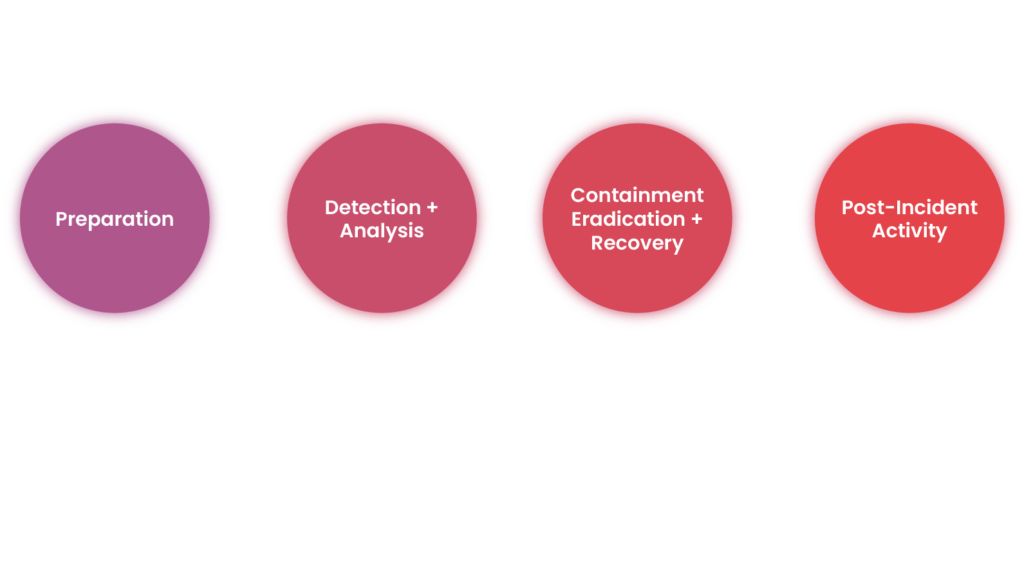
NIST SP 800-61 Incident Response Lifecycle: Step 1
Preparation
The preparation phase sets the foundation for a robust incident response framework. According to NIST SP 800-61, organizations need to develop a comprehensive incident response policy, procedures, and establish a dedicated team. The policy should define what constitutes an incident, outline response steps, and clarify roles and responsibilities. Preparation extends to regular training and simulations to ensure team readiness. Additionally, NIST stresses the importance of establishing communication channels both within the organization and with external entities like law enforcement and IT forensic experts, ensuring quick engagement when incidents occur.
Example of Preparation Activities
A company might develop an incident response policy that includes definitions of what constitutes an incident, outlines roles and responsibilities, and specifies the legal and regulatory requirements they must meet. For procedures, they might detail steps for reporting incidents, assessment processes, and communication strategies during an incident. Regular training sessions might involve tabletop exercises where the incident response team simulates different types of cyber-attacks to practice their roles and refine their response strategies.
NIST SP 800-61 Incident Response Lifecycle: Step 2
Detection and Analysis
Effective detection and analysis are crucial for minimizing the impact of security incidents. NIST SP 800-61 recommends employing diverse tools such as SIEM systems, intrusion detection systems, and antivirus software to monitor and analyze network behavior and alerts continuously. The response team must be adept at analyzing these alerts to distinguish between false positives and genuine incidents and understand the incident's nature, scope, and potential impact.
Example of Detection and Analysis Activities
An organization uses SIEM software to monitor and analyze logs from various network devices. If the SIEM detects unusual outbound traffic suggesting exfiltration of data, it triggers an alert for further analysis. The incident response team would then evaluate the alert to determine if it is a false positive or if it indicates a security breach, assessing the scope and impact to prioritize their response actions.
NIST SP 800-61 Incident Response Lifecycle: Step 3
Containment, Eradication, and Recovery
After detecting and analyzing the incident, the focus shifts to containing it to prevent further damage. NIST provides strategies for both short-term and long-term containment. Immediate short-term actions may involve disconnecting affected systems from the network to stop the spread of the attack. Long-term containment includes thoroughly sanitizing the environment to eliminate threats.
Following containment, the eradication process involves removing the threat and any associated vulnerabilities from the environment. The recovery phase aims to restore and verify system functionality for business operations, ensuring that all systems are cleansed and secured post-incident.
Example of Containment, Eradiation, and Recovery Activities
After a ransomware attack, an organization isolates affected systems from the network to prevent the spread of the malware as a short-term containment resolution. For long-term containment, they update and patch all systems to prevent exploitation of the same vulnerability. As for eradication, they remove the ransomware from all systems and restore data from backups. For recovery, they run comprehensive tests to ensure the systems are fully-functional and monitor to ensure the malware has been completely removed.
NIST SP 800-61 Incident Response Lifecycle: Step 4
Post-Incident Activity
The post-incident activity phase is crucial for learning and evolving from the incident. This involves conducting a detailed review of the incident, documenting lessons learned, and implementing improvements to the incident response plan. NIST SP 800-61 encourages organizations to use the insights gained to strengthen their security measures and response strategies, helping to mitigate the risk of future incidents.
Example of Post-Incident Activities
After resolving a phishing attack that resulted in data leakage, an organization conducts a post-incident review that reveals employees had difficulty identifying phishing emails. As a result, the organization decides to implement additional employee training on recognizing phishing attempts and to enhance their email filtering technology.
Conclusion
By understanding and implementing each phase of the incident response lifecycle set by NIST SP 800-61, organizations can enhance their preparedness, improve their response capabilities, and recover more effectively from cybersecurity incidents.
About ArmorPoint
ArmorPoint, LLC is a managed cybersecurity solution that combines the three pillars of a robust cybersecurity program — people, processes, and technology — into a single solution. Designed by cybersecurity experts, ArmorPoint’s cloud-hosted SIEM technology and extended detection and response capabilities enable businesses to implement a highly-effective, scalable cybersecurity program. With customizable pricing available, every ArmorPoint plan offers a dynamic level of managed security services that support the risk management initiatives of all companies, regardless of available budget, talent, or time. To learn more about ArmorPoint, visit armorpoint.com.